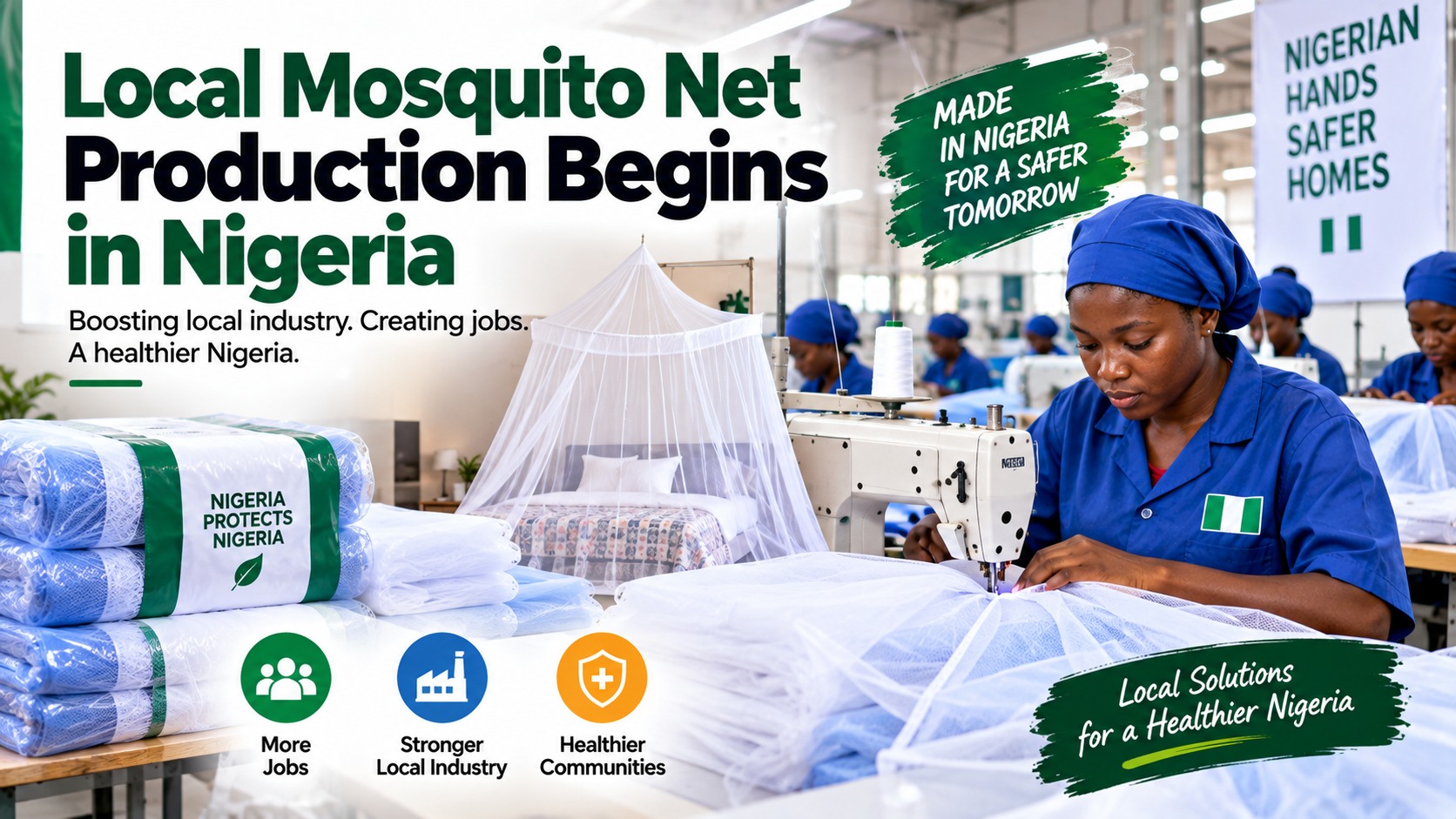
Nigeria has commenced local mosquito net production as the Federal Government moves to strengthen malaria prevention and reduce the country’s dependence on imported health products.
The development is expected to improve access to mosquito nets while also supporting local manufacturing, job creation and the broader development of Nigeria’s healthcare industry.
Local Mosquito Net Production to Strengthen Malaria Prevention
The production is being carried out by Health Textiles Nigeria FZE, a facility established by Swiss-based Vestergaard. The company has begun manufacturing PermaNet Dual, an insecticide-treated mosquito net designed to provide enhanced protection against mosquitoes that have developed resistance to some conventional insecticides.

The facility could produce up to 10 million mosquito nets annually when it reaches full capacity. The locally manufactured nets could also strengthen malaria prevention efforts as Nigeria continues to carry one of the world’s largest malaria burdens.
PermaNet Dual uses two active ingredients and has been prequalified by the World Health Organisation. Its technology provides stronger protection in areas where mosquitoes have developed resistance to commonly used insecticides.
The Coordinating Minister of Health and Social Welfare, Muhammad Ali Pate, welcomed the commencement of production. He described the development as an important milestone for Nigeria’s health sector and malaria-control efforts.
Factory Expected to Create More Than 600 Jobs
Beyond malaria prevention, the project could boost employment and healthcare manufacturing in Nigeria. The facility could create more than 600 jobs when it reaches full capacity. The company is also training workers in production, quality control, health and safety, and regulatory compliance.
The project follows a 2024 agreement between Vestergaard and the Presidential Initiative for Unlocking the Healthcare Value Chain. The agreement aimed to encourage greater local production of essential healthcare products.
The Federal Government’s support for local manufacturing could reduce Nigeria’s reliance on imported health commodities. It could also help limit the impact of international supply-chain disruptions.
With production now underway, Nigeria is taking another step towards building domestic capacity for essential healthcare products. The move could also strengthen the country’s efforts to combat malaria.