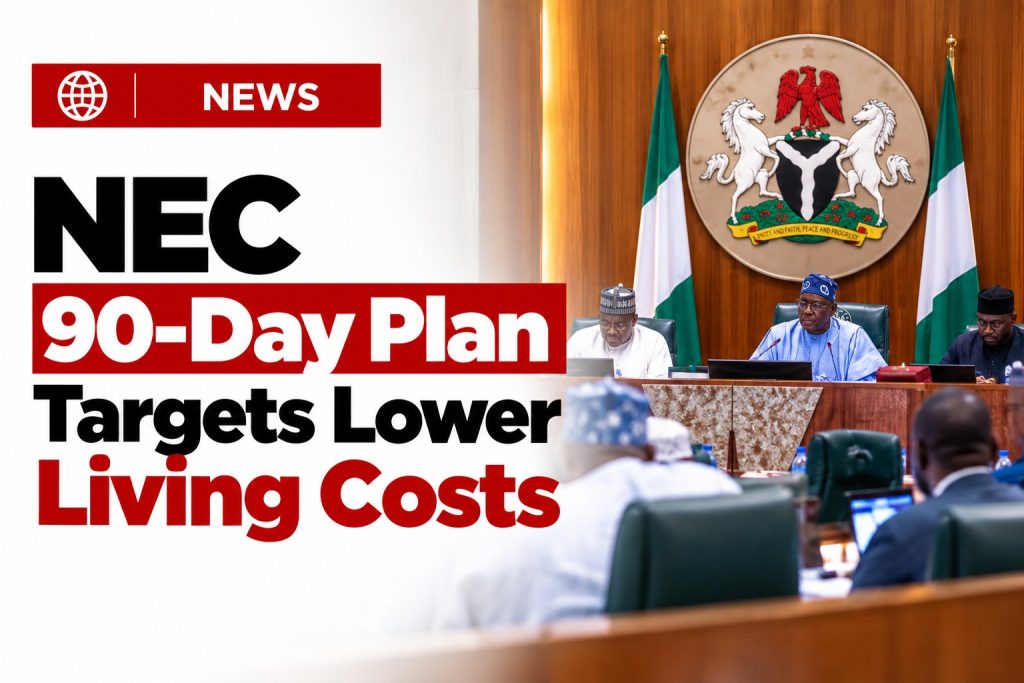
Nigeria’s National Economic Council (NEC) has endorsed a 90-day plan to reduce living costs. The initiative aims to improve food affordability, attract investment and support households facing rising expenses.
The council reached the decision on Thursday, October 22, 2026. Vice-President Kashim Shettima chaired its 161st meeting virtually. Finance Minister Taiwo Oyedele presented the plan on behalf of the Federal Ministry of Finance.
According to a statement from the Vice-President’s media aide, Stanley Nkwocha, the plan seeks to make economic reforms more beneficial to Nigerians.
However, the government has yet to release a detailed implementation schedule. It has also not explained the specific relief measures Nigerians can expect.


NEC 90-Day Plan Focuses on Five Priorities
The NEC 90-day plan focuses on five key areas. These include food affordability, tax harmonisation and the completion of major projects.
The other priorities are removing investment bottlenecks and providing regulated household support.
Through these measures, the council hopes to improve access to essential goods. It also aims to encourage investment and speed up projects that benefit citizens.
NEC also approved a national dashboard to track projects across the country. The platform will promote transparency and accountability. It will also help Nigerians monitor how the government spends funds saved from petrol subsidy removal.
Shettima urged state governments and relevant institutions to support the initiative. He stressed that economic reforms must improve people’s daily lives.
He also highlighted affordable transportation, accessible healthcare and job creation. Greater financial security remains another important goal.
NEC Targets Lower Transport Costs
The council also approved a joint financing framework for federal and state governments. The arrangement will support the deployment of compressed natural gas (CNG) and electric vehicles.
The initiative aims to reduce transportation costs. It could also provide commuters with more affordable travel options.
NEC further directed relevant authorities to engage transport unions and operators. The discussions will focus on passing fuel savings on to passengers through lower fares.
A committee will coordinate the financing arrangement. It will also consult stakeholders and develop practical measures for implementation.
Implementation Remains a Key Challenge
The plan has raised expectations about possible relief for Nigerian households. However, its success will depend on funding, coordination and effective implementation.
The government must also ensure that the proposed measures reach ordinary citizens. Lower food prices and transport fares would provide direct relief to struggling households.
For now, NEC’s endorsement marks a policy commitment. It does not mean living costs have already fallen.
Nigerians will be watching for further details from the government. The next 90 days will be important in determining whether the initiative delivers measurable results.
Until implementation begins, the impact of the plan remains uncertain. Households will need to wait for concrete measures that address the cost of essential goods and services.