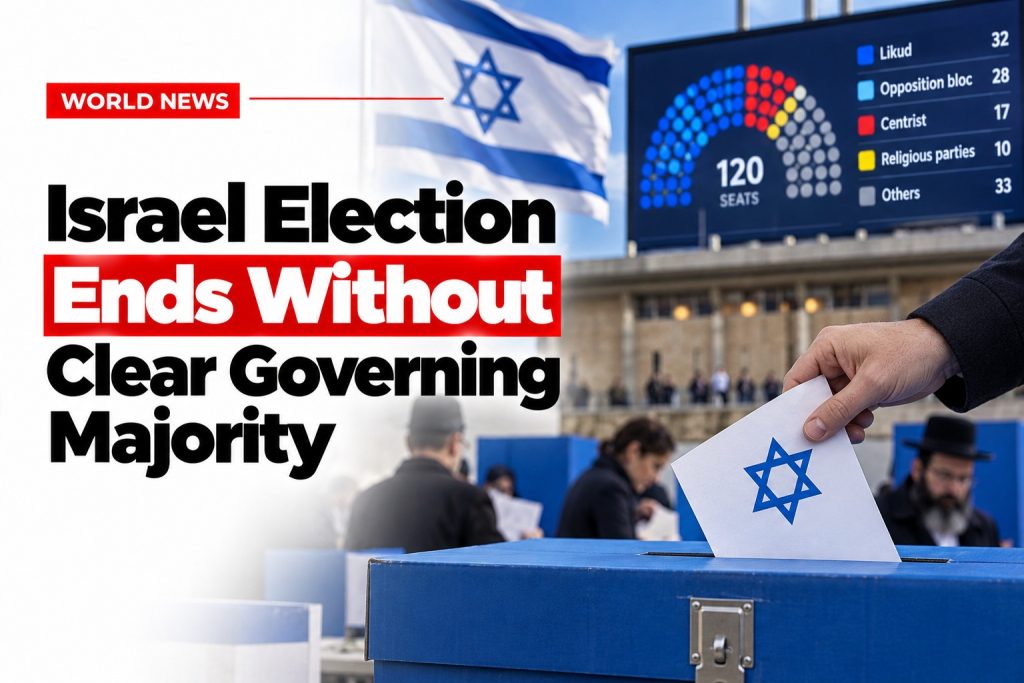
The Israel election on October 27 has ended without a clear governing majority. Prime Minister Benjamin Netanyahu and opposition leader Gadi Eisenkot now face challenges in forming the next government.
Early exit polls showed a close contest between the two political camps. Neither appeared to secure the 61 seats needed for a majority in Israel’s 120-member parliament, known as the Knesset.
The outcome could lead to weeks of coalition negotiations. Political parties must now seek alliances to secure enough parliamentary support. However, the final results remain uncertain as vote counting continues.


Israel Election Leaves Netanyahu and Opposition Short of Majority
Initial exit polls showed Netanyahu’s Likud-led bloc competing closely with Eisenkot’s opposition alliance. Likud emerged as the largest individual party in the preliminary projections. However, Netanyahu’s bloc fell short of the seats needed to govern alone.
Partial results released on Wednesday, October 28, also showed both camps below the required threshold. Reuters reported that Netanyahu’s bloc was projected to win 55 seats, compared with 50 for Eisenkot’s bloc. Officials had counted about 48.4 per cent of the votes at that stage.
Arab parties were projected to hold the remaining 15 seats. Their representation could become important during coalition negotiations.
However, these figures remain subject to change. Israel’s Central Elections Committee must complete the count before confirming the final results.
The election also recorded a turnout of 77.7 per cent. Electoral authorities described this as the highest participation rate in more than two decades.
Coalition Talks Could Decide Israel’s Next Government
Smaller parties could play a decisive role in forming the next government. Both major camps may need additional support to reach the 61-seat threshold.
However, securing that support may prove difficult. Netanyahu’s bloc has ruled out forming a government with Arab parties. Eisenkot has also expressed reservations about relying on them. These positions could limit the available options.
Netanyahu has called for a strong right-wing government. Meanwhile, Eisenkot argues that voters want a change in leadership. Their competing positions reflect Israel’s deep political divisions.
For now, Netanyahu remains caretaker prime minister. Political leaders must wait for the final figures before making decisive moves.
If neither camp secures enough support, Israel could face prolonged political uncertainty. Another election may also become a possibility if coalition negotiations fail.
The final results will determine each bloc’s bargaining power. Subsequent negotiations will then shape the country’s political direction.